Documents to Check Before Buying a Plot in India (Checklist)
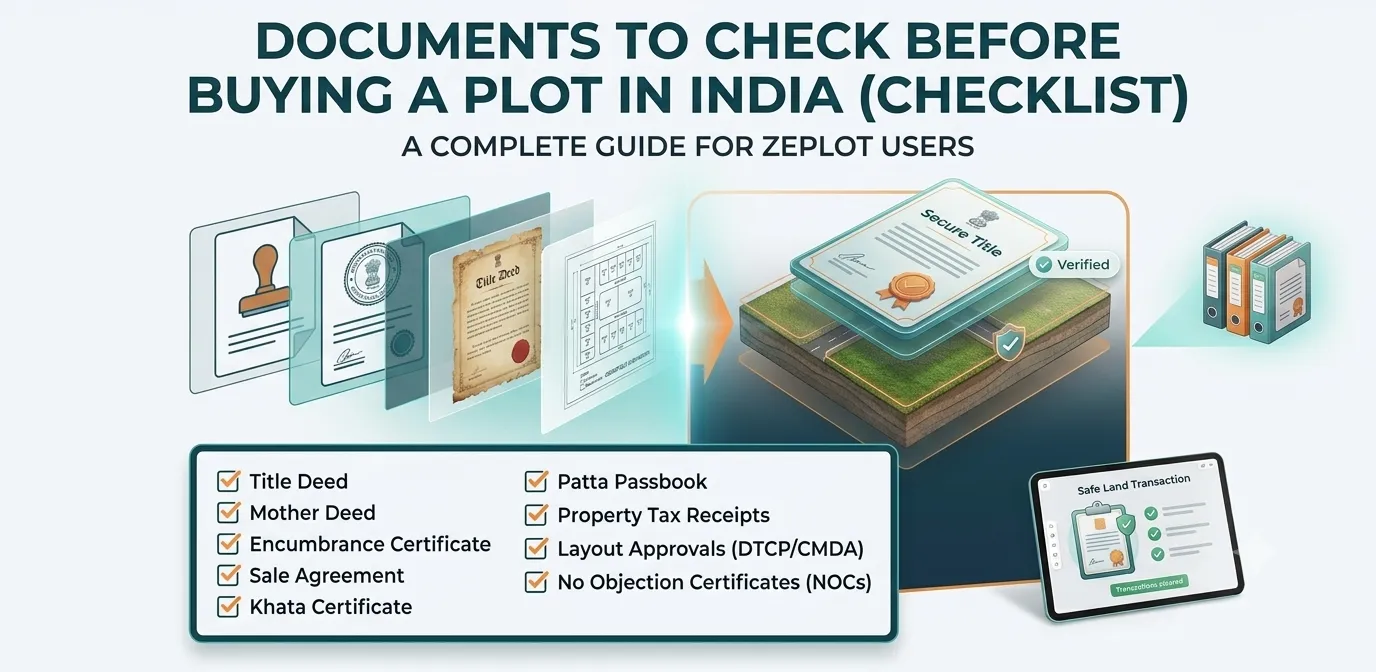
Before paying a booking amount, a careful buyer wants proof that the plot is legally clean and that the layout is genuine. This checklist lists the documents usually checked before buying a plot in India, what each one shows, and how developers can make the process easier by having everything ready.
Note: document names and rules differ between states, and this is general information, not legal advice. Buyers should have documents verified by a property lawyer before paying.
1. Title deed and chain of ownership
The sale deed (title deed) proves who owns the land now. Buyers and lawyers also look at the earlier deeds that show how the land passed from owner to owner, often going back several decades, to confirm the seller has a clear right to sell.
2. Land records (7/12 extract, RTC, patta or equivalent)
State land records show the owner, survey number, area and type of land. The document has different names in different states, for example the 7/12 extract, RTC or patta. The details should match the sale deed.
3. Mutation entries
Mutation records show that ownership changes were entered in the government records after each sale. Missing mutations can be a sign of an incomplete transfer.
4. Encumbrance certificate
An encumbrance certificate shows whether the land has registered loans, mortgages or other claims against it for a period of years. Buyers want to see it clear.
5. Land use conversion (NA order)
Agricultural land has to be converted for residential or commercial use in most states before it can be sold as plots. The conversion order confirms the permitted use.
6. Approved layout plan
The layout approved by the planning authority shows the plots, roads and open spaces as sanctioned. The plot being sold should appear on it with the same number and size. See how a plot layout plan is designed.
7. RERA registration, where it applies
Many plotted projects must be registered with the state real estate regulator. Where registration applies, buyers can look up the project on the state RERA website and check its details there.
8. Survey sketch and measurements
A survey sketch shows the boundaries and measurements of the land. On site, buyers check that the plot's boundary stones match these measurements.
9. Tax receipts and no-dues
Recent property tax receipts, and no-dues from the authorities where applicable, show that nothing is pending on the land.
10. Seller identity and authority
The person signing must be the owner or hold a valid power of attorney. For a company or firm, the authorisation to sign is checked too.
Plot buying checklist (summary)
| Document | What it confirms |
|---|---|
| Title deed + earlier deeds | Seller owns the land and can sell it |
| Land records (7/12 / RTC / patta) | Owner, survey no. and area in government records |
| Mutation entries | Past transfers recorded |
| Encumbrance certificate | No registered loans or claims |
| NA / land use order | Land may be used for plots |
| Approved layout | The plot exists as sanctioned |
| RERA registration | Project registered, where required |
| Survey sketch | Boundaries and measurements |
| Tax receipts | No dues pending |
| Seller ID / authority | Right person is signing |
For developers: have it ready before the first call
Most of these questions come up on every sale. Answering them before they are asked shortens the time from interest to booking:
- Keep a document set per project, ready to share with a buyer's lawyer.
- Put the survey numbers, approval reference and RERA number (where applicable) in the project details buyers see.
- Make sure plot numbers and areas are identical on the layout, the brochure, the 3D plot map and the booking form.
- Track which documents each buyer has received, so nothing is sent twice or forgotten.
Frequently asked questions
What documents are required for plot purchase?
At minimum the title deed, land records, encumbrance certificate, land use conversion, approved layout and seller identity, verified by a lawyer. Your state may require more.
How far back should ownership be checked?
Lawyers commonly look at the chain of ownership over several decades. Ask your lawyer what is usual in your state.
Can I check land records online?
Most states have online land record portals where records can be viewed by survey number. Verify important documents with a lawyer as well.
Want to see your own layout like this?
Get StartedMore from the blog
Is It Safe to Buy a Plot in Dholera? 9 Checks Before You Pay
Dholera is a real government project, but not every plot sold under its name is inside it. Nine checks to make before you pay.
Read more →
Dholera TP Schemes Explained: TP 1 to TP 6, Sub-Schemes and FP Numbers
What a TP scheme is, how Dholera’s six schemes and sub-schemes work, and how to find a plot’s FP number and zone.
Read more →
Devanahalli Plots: BIAAPA Approval, Khata and What to Check Before Buying
Buying a plot near Bengaluru airport? How to confirm the planning authority, DC conversion, BIAAPA approval, khata and K-RERA.
Read more →